

Latin Trap Fashion: The Visual Language of the Genre That Changed Everything
Before trend reports existed, before the fashion departments of the big brands figured out what was happening, there were artists building a complete visual language from their bedroom floors, from cheap recording studios, from neighborhoods that no fashion magazine had ever visited.
Latin trap didn't come to fashion. Fashion came to Latin trap. That distinction matters.
Because what Bad Bunny built in Vega baja, what Ryan Castro built in Medellín, what Big Soto and Neutro Shorty built from Caracas, what Blessd built from the streets of Guayabal, none of it was a calculated aesthetic designed to please anyone. It was the authentic visual expression of a generation that grew up between aspirational luxury and the reality of the block, that found in trap the first genre speaking to them directly, without euphemisms, without anyone softening the edges. That authenticity, that specificity of origin, is exactly what turned the trap aesthetic into the most influential fashion force in Latin music of the 21st century.
What Trap Saw Before Fashion Did
To understand why trap has such a defined visual language, you have to understand where the genre comes from and what it needed to say when nobody else was saying it.
Trap reached the Latin world from Atlanta, passed through Puerto Rico, and exploded across Latin America in the second half of the 2010s. It was born from the tension between two realities that mainstream music preferred to ignore: the street with all its implications, and the aspiration to leave it. It's not a genre of victims or of pure winners. It's the genre of the in-between, of someone who knows exactly where they came from and where they're going, and who isn't going to pretend the journey was clean.
That tension needed clothes to express it. Not the reggaeton of the 2000s, which looked toward conventional European luxury and yacht aesthetics. Not cumbia or vallenato, anchored in regional identity. Trap wanted something else: the combination of street references, the ones that give you credibility with the people who watched you grow up, alongside the symbols of success that used to be out of reach and were finally, for the first time, within grasp.
Oversized. Heavy chains. Limited sneakers. Flat brims. Brands the neighborhood already knew. That was trap's first language. And it was the right one.

How Trap Built Its Own Visual Code
Latin trap didn't adopt American trap aesthetics directly. It translated them. And in that translation, it created something new that's now recognizable in every corner of the Spanish-speaking world.
The elements of the Latin trap visual code are specific and consistent across artists, countries and generations.
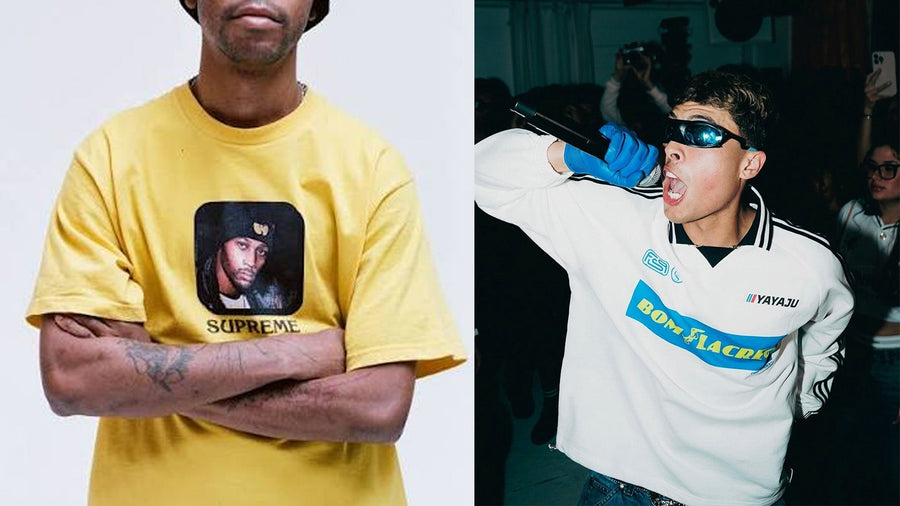
Oversized as a statement. Big clothes aren't carelessness. They're assertion. Trap understood before any fashion week that the fit that says "I know what I'm doing" is the one that doesn't fit exactly right. Three-sizes-up tees, pants that fall where they fall, jackets that wrap around you — all of it communicates a body that doesn't need the clothes to frame it to be seen.
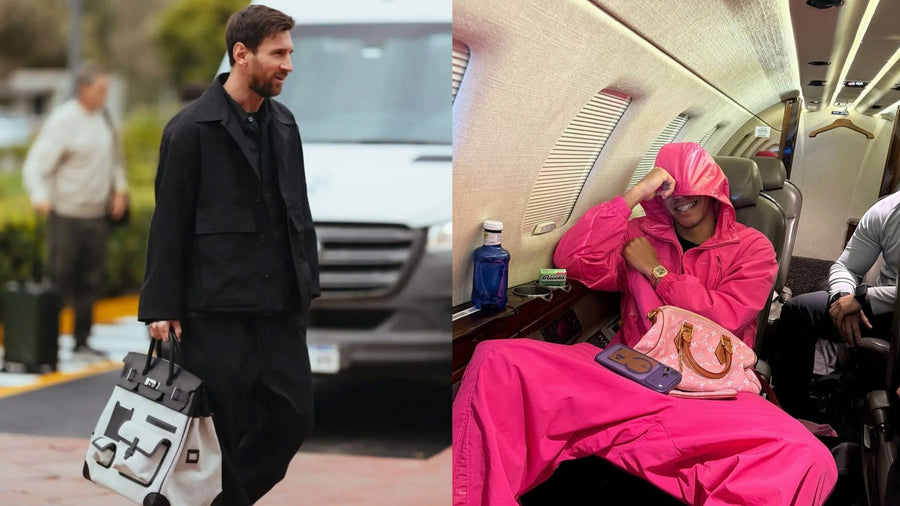
Luxury mixed with the everyday. A trap artist can wear a Rolex with a ten-dollar basic tee. Can pair Supreme or Chrome Hearts with something bought at the neighborhood market. That mix isn't ignorance of luxury's rules. It's deliberate rejection of them. Trap doesn't aspire to look upper class. It aspires to look like someone who came from the bottom and doesn't owe anyone a performance.
Jewelry as autobiography. Trap chains aren't accessories. They're life stories in gold. Each piece has a history, a meaning, a specific reference to where the artist came from. Trap understood that jewelry is where identity becomes visible in the most direct way possible.
Neighborhood references. The local team cap. The block's colors. The brand that existed in your street's stores before any influencer put it on. Trap keeps those references as anchors of authenticity, even when the artist can now buy anything in the world.
Bad Bunny and the Before and After of Trap Fashion
There is a before and after Bad Bunny in the relationship between Latin trap and fashion. Not because he was the first to understand it, but because he was the first to take it to a scale that forced the fashion world to pay attention.
Benito started his career in Vega baja, Puerto Rico, with the same aesthetic as any other trap artist of his generation: oversized clothes, chunky sneakers, visible jewelry, a darker color palette than traditional reggaeton. What set him apart over time wasn't that he abandoned that aesthetic. It was that he elevated it without betraying it.
His painted nails at a 2018 concert weren't a styling accident. They were a declaration that trap masculinity could be broader than what had been handed down to him. His Adidas collection wasn't an endorsement collaboration, it was a real dialogue between two identities. His floral shirt on a trap album cover wasn't a contradiction. It was expansion.
Bad Bunny proved that trap could be the starting point for a fully realized visual universe, with no limits by gender or category. That you could start on the block and end up in the front row at Paris Fashion Week, without anyone questioning you, because the origin was solid enough to hold any direction.

Colombia at the Center: Ryan Castro, Blessd and the New Urban Luxury
If Puerto Rico was Latin trap's original epicenter, Colombia is its most active creative capital today. Two artists in particular are redefining what it means to dress from within trap.
Ryan Castro came from the working-class neighborhoods of Medellín with a visual proposition that mixes the most explicit luxury, Dior, Louis Vuitton, five-figure jewelry pieces, with references so specific to his origin that they're impossible to imitate from the outside. His videos aren't pop artist productions that adopted trap aesthetics. They're documents of someone who lived what he sings and who can now buy whatever he wants without forgetting where he came from. That tension, memory and ascent at the same time, defines his image.
Blessd, from Guayabal, has a different but equally consistent visual code. More raw, more street, less interested in aspirational luxury and more in neighborhood authenticity. His outfits mix streetwear brands with local clothing, sneakers with real history, pieces that anyone who grew up in a working-class Medellín neighborhood can recognize as genuine. What makes him visually compelling is exactly that: there's no distance between who he is in the clothes and who he is in life.
Both artists are creating something with a specific name in fashion: a new Latin American urban luxury. A luxury that doesn't imitate European luxury or aspire to it. One that takes what it finds interesting in conventional luxury and recombines it with references that are exclusively its own.

Venezuela and the Trap Scene the World Is Starting to Watch
For years the conversation about Latin trap moved as if it were exclusively a Puerto Rican, Colombian or Mexican phenomenon. But there's a scene that has been building something real for a long time, with artists who already have millions of listeners and who are reshaping what trap can sound and look like when it comes from Venezuela.
Big Soto is the name that carries the most weight in that conversation. Daniel Soto grew up in Caracas and understood from an early age that trap wasn't just a music genre but a way of existing. His aesthetic blends very specific Caribbean references, the palette of the Caribbean, the relaxed attitude of someone who doesn't need to try to be seen, with the urban trap visual code: oversized, chains, the right sneakers, and above all a visual consistency that doesn't change based on the occasion. Big Soto doesn't dress differently in a video than he does on the street. In trap, that's everything.
Neutro Shorty is the other name you can't overlook. Raúl Ruiz built a career from Venezuela that today has real regional reach, with collaborations that place him on the same level as the most listened-to artists in Latin trap. His visual proposition has something that few artists of his generation manage to pull off: it's completely his own. He doesn't imitate the Colombian luxury look or the Puerto Rican style. He wears what represents him, with a confidence that comes from knowing exactly who he is and where he came from.
What Big Soto and Neutro Shorty are doing together, and each on their own, is proving that Venezuelan trap isn't a second-tier version of Latin trap. It's its own chapter, with its own references, its own visual vocabulary, and its own story to tell. A story that combines diaspora, the nostalgia of a country that many of them know from the outside, and the reality of growing up between cultures.
That specific experience, of the Venezuelan who moves through the world without stopping being from Caracas, is the same one that gives life to brands like Caracas Merch. When a Venezuelan trap artist wears a piece that speaks to that identity, they're not making a fashion choice. They're saying something about who they are that no international brand could say for them.

What Trap Artists Are Wearing in 2026
The Latin trap aesthetic in 2026 has evolved from its early years but maintains its structural principles. These are the categories defining what's being worn right now.
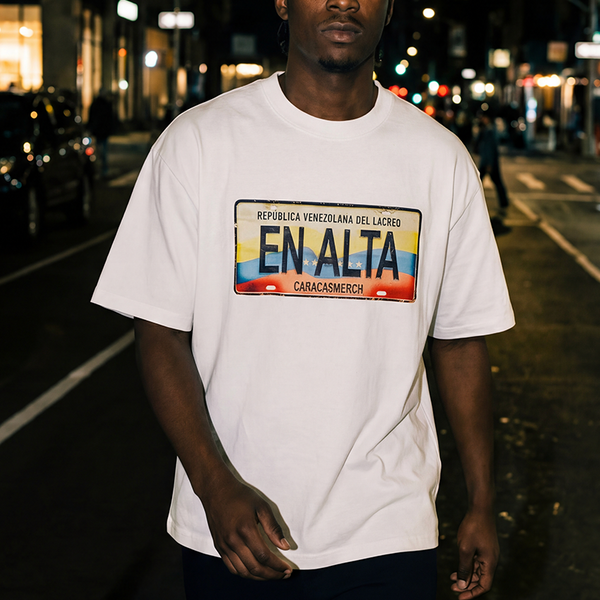
Oversized tees with graphics. The T-shirt remains the main canvas of trap identity. The graphics have matured: less loud typography, more designs with specific meaning, more visual references that require context to understand. The brands that get this produce pieces that function as code. If you know, you know.
Wide-leg jeans or cargo pants. The slim cut disappeared from trap years ago. Wide pants, cargo pants with functional pockets, baggies that fall with their own weight, the bottom half of a trap outfit is always volumetric, always with presence.
Sneakers with a story. Not necessarily the most expensive on the market, but ones with a narrative. Air Force 1s remain a reference point. Special edition Jordans. New Balance making its return with real force. Trap knows that sneakers tell stories and chooses the ones that have something to say.
Visible chains and accessories. Jewelry doesn't hide. Chains, rings, earrings, all visible, all intentional. Trap democratized access to quality jewelry and built a culture where spending on pieces is a legitimate way of expressing the distance traveled.
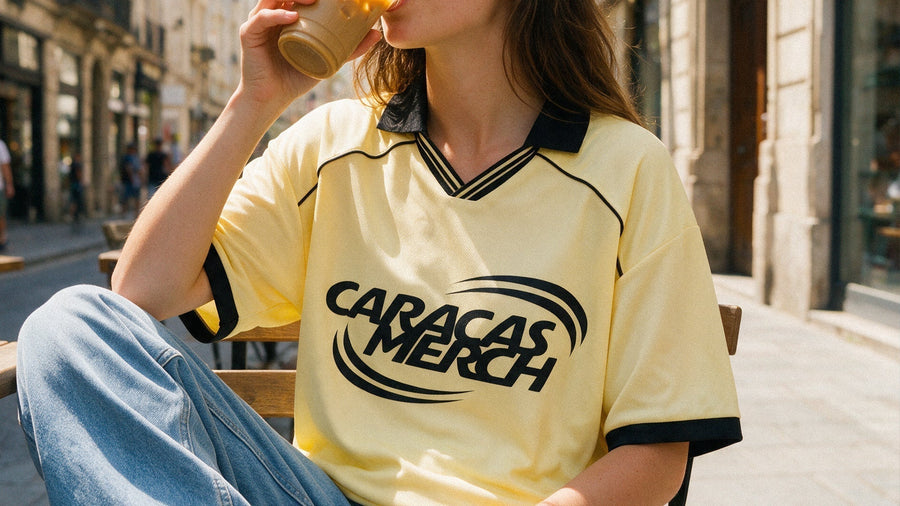
Brands with their own identity. Trap doesn't wear brands for the logo. It wears them because they say something. Chrome Hearts, Rhude, ERL, and in the Latin space, independent brands that speak the language of the diaspora and the street. Caracas Merch falls into that category — built from the same experience that Venezuelan trap artists carry in their lyrics, with pieces that work as identity statements rather than advertising.
Why Trap Needs Brands That Speak Its Language
Latin trap has a relationship with authenticity that's more demanding than almost any other music genre. Its audiences, people who in many cases lived the same things the artists sing about, have a very precise sensor for detecting what's real and what's performance.
That creates a specific demand from brands trying to enter that space. Not just any brand can enter trap. The ones that try from the outside, from marketing strategy, from trend analysis, usually fail or get ignored. The ones that belong there because they were built from the same streets and the same experiences that trap sings about are the ones that end up becoming part of the genre's visual vocabulary.
What trap asks of a brand is the same thing it asks of an artist: be specific, have a clear origin, know who you are. A brand born from the Venezuelan diaspora, that built its identity from the pride of being from where you're from and carrying that without apology, has natural access to trap's language. Not because it calculated the move, but because it comes from the same place.
Trap and Streetwear: What Comes Next
Trap's influence on global streetwear isn't a seasonal trend. It's a deeper reconfiguration of who holds the power to define what's relevant in fashion.
For decades that power was concentrated in a handful of cities: Paris, Milan, New York, Tokyo. Trap, alongside hip hop, Afrobeats, and K-pop, is redistributing that power in a way that's already irreversible. The centers of aesthetic influence today are also Medellín, San Juan, Miami, Caracas, and the cities where the Latin diaspora lives, the people who came from Venezuela, Colombia, Mexico, the Dominican Republic.
The brands that will define the next chapter of streetwear aren't necessarily the ones with the biggest budget. They're the ones with the most authentic identity for the communities that trap is turning into global references. The ones that know how to speak the language before anyone teaches them the words.
That's what's at stake. And Latin trap, with its honesty about origin, its rejection of performance, its mix of street and aspiration, is going to keep being the place where that language gets built first.
FAQ
What is Latin trap fashion? Latin trap fashion is the visual code that emerged from Latin trap artists: oversized clothing, visible jewelry, sneakers with history, a dark color palette mixed with luxury pieces. It wasn't designed by the industry. It emerged organically from artists like Bad Bunny, Ryan Castro, Big Soto and Neutro Shorty, and the fashion industry adopted it after the fact.
How do Latin trap artists dress? Latin trap artists combine oversized clothing with selected luxury pieces and direct references to their origins. The key isn't the price of what they wear but the coherence of the message. The mix of aspirational and neighborhood-authentic is what defines the style.
Who are the most important Venezuelan trap artists? Big Soto and Neutro Shorty are the two names that have done the most to put Venezuelan trap on the Latin trap map. Both built careers with their own visual identity, without imitating other scenes, and today carry real relevance beyond Venezuela. Their presence proves that Venezuelan trap has its own chapter in the genre's history.
What brands do trap artists wear? Chrome Hearts, Rhude, Off-White, Supreme, New Balance, Jordan Brand and, in the Latin scene, independent brands with genuine cultural identity. Trap prefers brands that say something about who you are. Caracas Merch has presence in that space because its identity is authentic to artists coming from the Venezuelan diaspora and Latin urban culture.
What's the difference between reggaeton fashion and trap fashion? 2000s reggaeton looked toward conventional European luxury and mainstream success aesthetics. Latin trap has a more complex relationship with luxury: it uses it, but mixes it with neighborhood references and an attitude that never forgets the origin. Trap doesn't aspire to look wealthy. It aspires to look like someone who came from the bottom and doesn't owe anyone a performance.
Why did Latin trap influence global fashion so much? Because Latin music is the most consumed genre on the planet and its artists are cultural references for hundreds of millions of people. When Bad Bunny shows up at Paris Fashion Week, he's not asking the industry for permission. The industry is acknowledging that the power to define what matters has changed hands. Trap was one of the mechanisms that produced that shift.
How can I dress like a Latin trap artist? The trap principle isn't to spend more — it's to be more specific. An oversized tee with a graphic that says something about you, wide-leg pants, sneakers with history, and a chain that's actually yours. Trap spots performance immediately. What it can't spot, because it's impossible to fake, is genuine origin.