

The Shift in Streetwear: From Looking Good to Meaning Something
For a long time, streetwear was easy to understand.
If it looked good, it worked.
Clean fits.
Neutral tones.
Minimal logos.
That was enough.
But something started to feel off.
Because when everything looks good,
nothing feels personal.
In 2026, that’s what’s changing.
Denim Tears Photo
When Streetwear Became Too Clean
At some point, streetwear stopped taking risks.
It became more refined.
More minimal.
More “acceptable.”
Brands leaned into:
perfect color palettes
safe silhouettes
subtle branding
And for a while, that worked.
But as more brands followed the same formula, everything started to look the same.
You could look at different collections
and feel like you had already seen them before.
Streetwear didn’t lose quality,
it lost intention.

The Return of Identity in Fashion
Today, people aren’t just looking for design.
They’re looking for meaning.
Clothing is becoming personal again, not just something you wear, but something that represents something.
Where you’re from.
What you relate to.
What you stand for.
That’s the real shift:
people are no longer dressing to fit in, they’re dressing to represent.

It’s Not About Being Louder
This shift doesn’t mean streetwear is becoming more loud.
It’s not all oversized graphics, bold colors, or exaggerated pieces.
In fact, some of the most interesting work right now is:
clean
precise
minimal
But with something that was missing before:
intention.
Because the problem was never minimalism.
It was minimalism without context.
Today, a simple piece can carry more weight
than a complex one:
if there’s identity behind it.

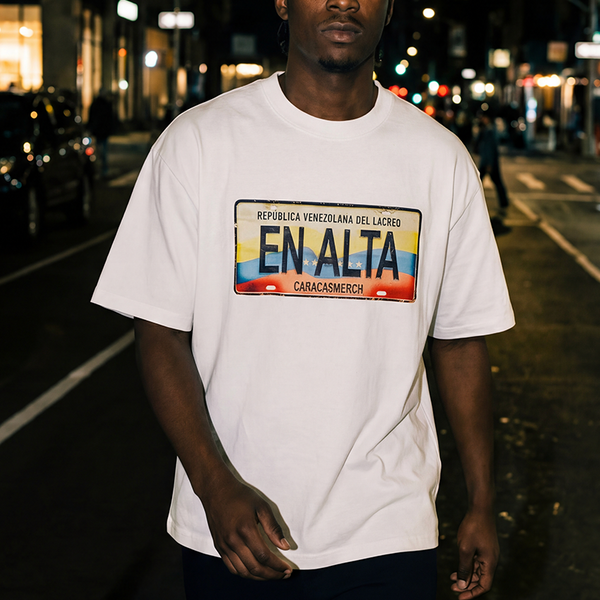
Shop En Alta Shirt by Caracas Merch
Diaspora Is Changing the Point of View
Streetwear has always been global.
But now, the influence is shifting.
The most interesting ideas are no longer coming from traditional fashion centers.
They’re coming from:
Latin America
Africa
the Caribbean
immigrant communities in the U.S. and Europe
That’s diaspora.
And diaspora creates something different:
a mix of identities
a tension between cultures
a need to express something real
That tension becomes design.
Corteiz and Denim Tears Collaboration
The Brands Building From Meaning, Not Just Design
Some brands are already operating from this place, not as a trend, but as a foundation.
Denim Tears builds through history, using clothing as a medium to tell narratives tied to the African diaspora and turning product into cultural context.
Caracas Merch builds through language, transforming Venezuelan slang into visual codes that work globally without needing translation.
Corteiz does it through community and rebellion, creating a brand that feels more like a movement than a company.
Who Decides War takes a more artistic approach, using denim as a storytelling medium.
Kapital shows how heritage, craft, and traditional techniques can evolve into contemporary identity.
Different regions.
Different languages.
Different aesthetics.
Same principle:
they’re not designing to look good,
they’re designing from what they represent.
Why Meaning Scales More Than Aesthetic
Aesthetic-driven brands can grow fast.
But they’re also easy to replace.
Because trends move.
What feels fresh today
feels outdated tomorrow.
Meaning works differently.
When someone connects with what you represent, they don’t just like the product — they relate to it.
And that creates something stronger than hype:
it creates loyalty.
Because even the simplest piece,
when it carries identity,
becomes recognizable.
What Comes Next for Streetwear
The next phase of streetwear won’t be defined by:
minimalism
perfect branding
or clean design systems
It will be defined by:
identity
narrative
origin
And this is already happening.
The brands gaining traction today
are the ones building community, telling stories, and creating pieces that resonate beyond aesthetics.
Final Thought
Streetwear isn’t becoming louder.
It’s becoming more precise.
More intentional.
More honest.
And in that shift,
it’s no longer the loudest brand that wins.